Company Profile
Latest Updates
Provide you with the latest enterprise and industry news
2026-10-15
You are sourcing a polyester shell for a new backpack line, a uniform fabric, or a lightweight outdoor jacket. The brief lists two candidates: oxford polyester and canvas polyester. At first glance they share the same fiber family, similar color cards, and overlapping price points. The real difference is the weave geo...
2026-10-08
When a supplier presents a sample book of lightweight suitings, the label that comes up most often is “65% polyester, 35% rayon.” Manufacturers choose this blend for a simple reason: it offers controlled cost, easy cutting, stable seams, and a soft hand feel that customers associate with better garments. But the same ...
2026-10-01
What Are Crepe Materials? A Buyer's Starting Point If you need a fabric that pairs relaxed softness with a fluid, body-friendly drape, crepe materials are a strong candidate. Crepe is produced by weaving hard-twisted yarns in opposing S and Z directions, and that yarn structure creates the fine pebbled surface that de...
Industry Knowledge
Digital Printed Crepe Fabric demands specialized preprocessing to ensure ink adherence across the fabric's undulating surface. The high-twist yarn structure creates microscopic valleys that standard inkjet formulations struggle to penetrate uniformly, often resulting in mottled color distribution. HUZHOU XINDING IMPORT & EXPORT CO., LTD. has found that applying low-viscosity pre-coatings (4-6 cP) specifically formulated for cellulosic substrates significantly improves drop spread control and minimizes color bleeding between peaks and troughs.
Production speed adjustments prove critical—reducing printhead traverse rates by 15-20% compared to flat-weave substrates allows adequate dwell time for ink absorption without compromising line sharpness. For metallic or pearl-effect digital prints on crepe, additional fixation passes using infrared drying between color layers prevent surface pooling that would otherwise obscure the substrate's characteristic tactile dimensionality.
The inherent elasticity of Pure Cotton Crepe Fabric stems entirely from yarn torque rather than fiber elasticity, distinguishing it fundamentally from knitted stretch fabrics. Weft yarns twisted at 1,400-1,800 TPM (turns per meter) generate sufficient internal stress to create the signature crinkled appearance upon relaxation, yielding fabrics with 15-25% extensibility despite woven construction. This mechanical stretch recovers partially after deformation, though prolonged tension causes permanent deformation known as "growth."
Garment designers must anticipate directional behavior—cotton crepe exhibits greater stretch and recovery in the weft direction compared to the relatively stable warp. HUZHOU XINDING IMPORT & EXPORT CO., LTD. advises pattern makers to align garment lengthwise grains with the warp to minimize sagging in finished pieces, particularly for bias-cut designs where weft-dominant drape might otherwise distort intended silhouettes over time.
Successful pattern development for Cotton Printed Crepe Fabric requires accounting for optical interference caused by surface irregularities. Fine geometric patterns or precise stripes often appear wavy or distorted when applied to crepe substrates, whereas organic motifs and diffused designs harmonize with the fabric's natural texture. Minimum pattern element sizes of 3mm generally maintain visual integrity; smaller details risk disappearance into surface crevices or unintended moiré effects.
Color saturation presents another variable—crepe's shadowed recesses absorb light differently than raised portions, causing solid color fields to appear subtly variegated. Designers increasingly leverage this phenomenon through tone-on-tone printing that exploits the fabric's dimensional texture rather than fighting against it. Quality verification should include evaluation under multiple lighting angles to confirm consistent appearance across varied viewing conditions.
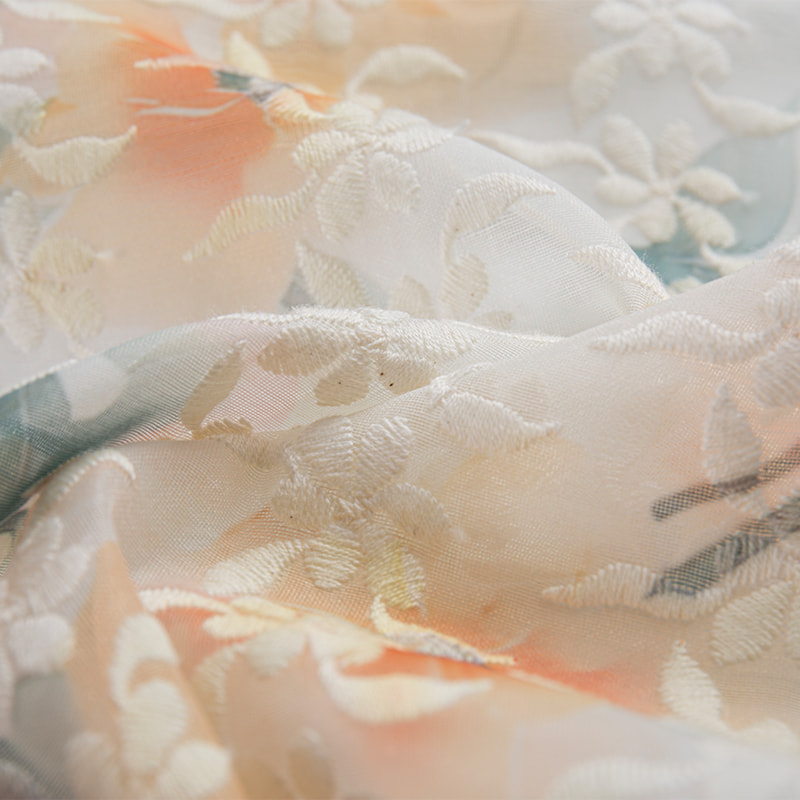
Floral Crepe Fabric continues to drive revenue in women's contemporary and bridge market segments, with print direction evolving toward hand-painted aesthetics and imperfect repeats that signal artisanal authenticity. The crepe substrate's movement amplifies these designs, creating kinetic visual interest as garments shift with wearer motion. Current preference leans toward sparse, asymmetric floral placement rather than dense all-over patterns, allowing the fabric's textural character to share visual prominence.
Technical execution challenges include maintaining registration accuracy across the fabric's unstable width—crepe substrates can vary ±3% in lay-flat dimensions depending on humidity and tension history. Digital printing systems with inline fabric tension monitoring and adaptive printhead positioning compensate for these variations, ensuring botanical elements align correctly across panel seams in finished garments.
Supply chain transparency remains paramount for floral print sourcing, as botanical motifs frequently appear in sustainability-marketed collections where fiber provenance and dye chemistry face heightened scrutiny. HUZHOU XINDING IMPORT & EXPORT CO., LTD. emphasizes comprehensive documentation from raw material through finished fabric to support clients' compliance requirements and consumer communication strategies.
Contact Information
Add:
No. 517 Huanzhu Road, High-Tech Zone, Wuxing District, Huzhou City, Zhejiang Province, China.
E-mail:
Product Category
QR Code
Join our community and stay connected
 English
 Español
 عربى
عربى