2026-08-20
Content
Every roll of satin fabric begins as a decision about geometry rather than fiber. Satin is defined by a weave pattern, not by a single raw material, and that distinction explains why the fabric can be produced from silk, polyester, nylon, or blended yarns while still delivering the same glossy face and dull back.
In a plain weave, each weft yarn passes over one warp yarn and under the next, creating frequent interlacing points. Satin weave structure works differently. A weft yarn floats over four or more warp yarns before it dips under a single one, and the next float is offset so the interlacing points never line up in a visible diagonal. This staggered pattern is what separates satin from twill, where the diagonal rib is intentional and visible.
The length of each float directly controls how much light the surface reflects. Longer floats expose more parallel yarn segments to the eye, and parallel fibers reflect light in a more unified direction than fibers locked into frequent crossings. That unified reflection is what the textile trade calls luster, and it is a mechanical outcome of the weave geometry rather than a chemical finish applied afterward.
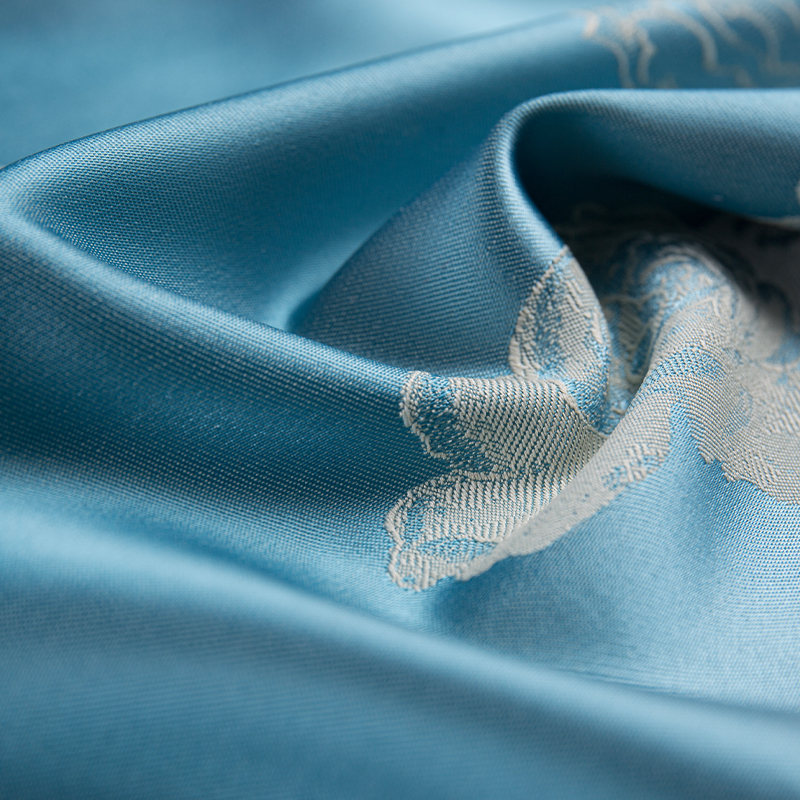
Satin weaves are typically described by harness count, most commonly four-harness, five-harness, or eight-harness constructions. A five-harness satin, sometimes called a crow satin, interlaces one weft yarn for every four it floats over, while an eight-harness satin extends the float even further before the next interlacing point. Higher harness counts generally produce a smoother, glossier surface but also reduce the fabric's structural stability, which is why mills balance harness count against intended end use rather than maximizing sheen alone.
Beyond the weave pattern itself, the density of warp and weft yarns per inch, along with the denier or yarn count used, determines the final weight and hand of the fabric. A lightweight satin intended for a blouse lining might run in the range of sixty to eighty grams per square meter, while a heavier decorative satin used for drapery or bridalwear can exceed one hundred fifty grams per square meter. Mills adjust reed density and pick count to hit a target weight without sacrificing the float length that gives satin its identity.
Buyers evaluating satin for apparel, bedding, or lining rarely need a chemistry lesson; they need a working list of what the fabric will and will not do on the cutting table and in daily use.
Glossy face, matte back, produced by float length rather than coating.
Fluid, body-hugging drape due to fewer interlacing points restricting yarn movement.
Low friction surface, which aids cutting speed but complicates seam stability.
Long floats are more prone to snagging than tightly interlaced plain weaves.
Satin does not insulate as effectively as a napped or brushed fabric because the smooth, tightly aligned surface traps less air. This makes it a poor choice for cold weather insulation on its own, but a strong choice as a lining that allows an outer insulating layer to slide on and off the body with minimal resistance. During cutting and sewing, the same low friction that aids drape also means the fabric shifts easily on the cutting table, so most production facilities pin or weight the fabric heavily and cut with a rotary blade rather than shears to maintain pattern accuracy.
Because satin has fewer interlacing points holding each yarn in place, seams cut on the bias or along tight curves are more prone to puckering or slipping during stitching. Production teams commonly address this with a narrower stitch length, tissue paper stabilization under the presser foot, or a walking foot attachment that feeds both fabric layers evenly. French seams or bound seams are frequently specified for satin garments to prevent the raw edges from fraying in wear and in washing.
Polyester satin material refers to satin woven from polyester filament yarn rather than silk or a blended yarn. Because polyester filaments are naturally smooth, continuous, and uniform in diameter, they are well suited to the long-float structure that satin weaving requires, which is one reason polyester satin has become widely available at accessible price points.
| Property | Behavior in Polyester Satin |
|---|---|
| Moisture Absorption | Low, dries quickly, does not swell with humidity |
| Dimensional Stability | High, resists shrinking and stretching during washing |
| Heat Sensitivity | Softens at elevated ironing temperatures, requires low heat settings |
| Static Buildup | Higher than natural fiber satin, especially in dry conditions |
| Colorfastness | Generally strong under disperse dyeing methods |
Two structural variants dominate the polyester satin category. Monofilament based satin uses a single continuous strand per yarn, producing a crisper hand and sharper sheen. Multifilament based satin bundles many fine strands together, softening the drape and reducing the glassy appearance, which is often preferred for garment linings and sleepwear.
Polyester fiber is hydrophobic, which means standard reactive or acid dyes used on cotton or silk will not bond effectively with it. Instead, polyester satin is colored through disperse dyeing, a process that uses fine dye particles suspended in a carrier solution and applied under heat and pressure so the dye molecules migrate into the fiber structure itself. This process tends to produce excellent wash fastness and resistance to fading from repeated laundering, though matching an exact custom shade can require more precise process control than piece dyeing natural fibers.
Many commercial satins are not pure polyester but blends that combine polyester filament with small percentages of spandex for stretch, or with viscose for a softer hand and improved breathability. A blend containing four to six percent spandex, for example, allows a satin gown to retain its sheen and drape while accommodating fitted seams that would otherwise restrict movement. Buyers sourcing satin for performance-adjacent applications, such as costume or dancewear, should always confirm blend ratios rather than assuming a listing labeled satin is one hundred percent polyester.
Charmeuse fabric and crystal satin are frequently confused because both share the glossy face and matte back that define satin generally, but they diverge in weight, hand, and typical end use.
| Attribute | Satin Charmeuse | Crystal Satin |
|---|---|---|
| Typical Weight | Light to medium | Medium to heavy |
| Surface Character | Soft, fluid, slightly matte sheen | Crisp, high gloss, glass-like reflection |
| Common Fiber | Silk, polyester, or viscose blends | Polyester filament, often high denier |
| Drape | Clings closely to the body | Holds structure, supports fuller silhouettes |
| Typical Use | Blouses, lingerie, lining, eveningwear | Bridal gowns, formalwear, decorative drapery |
The practical takeaway for buyers is that charmeuse behaves closer to a second skin, while crystal satin behaves closer to a structural shell. Choosing between them is less about quality and more about how much body the finished garment needs to hold on its own.
When a swatch is held up to a light source, charmeuse tends to show a softer gradient of sheen across folds because its lighter weight allows it to fall into looser curves. Crystal satin holds sharper, more defined fold lines and reflects light in narrower, brighter bands. Running a fingernail lightly across the surface also reveals a difference: charmeuse yields and moves under light pressure, while crystal satin feels firmer and springs back into shape more quickly, a result of its higher yarn density and often higher denier filament.
Weight and fiber content are the two biggest drivers of price difference between the two variants. A silk charmeuse commands a premium tied to raw fiber cost, while a polyester crystal satin is priced more around yarn denier, finishing complexity, and order volume. For buyers working within a fixed budget, a polyester charmeuse-style satin can approximate the soft drape of silk charmeuse at a lower cost, while a heavier polyester duchesse satin can substitute for crystal satin in structured garments without the premium associated with imported silk blends.
The diagram below illustrates how a five-harness satin weave staggers its interlacing points compared to a plain weave, producing the long uninterrupted floats responsible for satin luster.
The question of whether polyester satin is good for hair comes up most often around pillowcases, bonnets, and hair wraps. The relevant factor is surface friction, not brand or price point.
Hair cuticles lie flatter and sustain less mechanical stress against a low friction surface. Because polyester satin is woven with long floats and smooth filament yarn, it reduces the tugging and static that rougher weaves like flannel or standard cotton percale can cause overnight.
Polyester fiber absorbs very little moisture, so a pillowcase made from woven satin textiles will not pull hydration out of hair the way some absorbent weaves can, but it also will not add moisture back. For very dry hair types, a light leave-in product paired with polyester satin tends to outperform polyester satin used alone.
Cotton percale, while breathable, has a tighter, more textured surface that generates more friction against hair strands overnight, which can contribute to tangling and mechanical breakage over repeated nights of contact. Flannel adds even more surface texture through its brushed finish, making it one of the higher friction options despite its warmth benefits in cold climates. Silk satin sits closest to polyester satin in terms of low friction performance, with the added benefit of natural moisture regulation, though it typically requires more careful laundering and a higher purchase cost. For most households, polyester satin offers a practical middle ground: friction reduction close to silk, at a price and durability profile closer to cotton.
Selecting a tightly woven, higher density polyester satin rather than a very lightweight version will generally hold up better to repeated washing without pilling. Washing on a cool or warm cycle with a mild detergent and avoiding fabric softener helps preserve the smooth surface finish, since softener residue can build up on synthetic fibers over time and reduce glide. For those in dry climates concerned about static, a light mist of water or a leave-in product applied before sleep can offset both the static tendency and the lack of moisture absorption inherent to polyester fiber.
Selecting the right satin construction is a matter of matching weight, drape, and surface behavior to the demands of the finished product.
Testing a swatch under the intended lighting and against the intended lining fabric remains the most reliable way to confirm sheen and hand before committing to a full production run.
Most polyester and blended satin performs best on a gentle machine cycle in cold or lukewarm water, placed inside a mesh laundry bag to reduce surface abrasion against zippers, hooks, or rougher fabrics in the same load. Air drying or a low tumble dry setting helps prevent the heat sensitivity that can cause polyester filament to soften and lose its crisp sheen. For storage, hanging padded hangers work better than folding for garments, since sharp folds can create permanent creases in the long floats that define the weave, while flat folding with acid-free tissue is preferable for yardage held in inventory.
Snagging is the most frequent complaint with satin, and it typically originates from rough contact with jewelry, velcro, or unfinished nails on furniture rather than from a defect in the fabric itself. Pilling, by contrast, is more common in lower grade polyester satin where shorter, lower quality filament fibers break down under friction and roll into small balls on the surface. Color shifting after repeated washing usually points to insufficient dye penetration during the disperse dyeing process, which is why sourcing from mills with consistent process control matters more for satin than for many other weave types.
Satin refers to a weave structure, while silk refers to a fiber. Silk can be woven into satin, but so can polyester, nylon, or viscose, so the two terms are not interchangeable.
Polyester satin is fabric woven in the satin structure using polyester filament yarn, which gives it low moisture absorption, quick drying, and strong dimensional stability compared to natural fiber satin.
Yes, in terms of reducing friction and mechanical stress on hair strands, though it does not add moisture the way some natural fibers can, so pairing it with a hydrating routine is common practice.
Charmeuse is generally lighter, softer, and more fluid in drape, while crystal satin is heavier, crisper, and holds structure better, making it more common in bridal and formalwear.
The long floats that create satin's sheen also leave individual yarns less locked in place, which makes the edges more prone to fraying and the surface more susceptible to snagging on rough contact.
Yes, a glossy face paired with a distinctly duller back and no visible diagonal rib is the clearest visual signal of a true satin weave, distinguishing it from twill or plain weave alternatives.
Not necessarily. Sheen level is primarily a function of float length and fiber smoothness rather than overall fabric quality, so a lower sheen satin can still use higher grade yarn, tighter density, and stronger colorfastness than a shinier but thinner alternative.
Related Products
Get in Touch
We're here for you when you need us.
Contact Information
Add:
No. 517 Huanzhu Road, High-Tech Zone, Wuxing District, Huzhou City, Zhejiang Province, China.
E-mail:
Product Category
QR Code
Join our community and stay connected
 English
 Español
 عربى
عربى