English
 Español
 عربى
عربى

Introduction: Why Fabric Choice Defines Summer Comfort
When designing or selecting summer clothing, especially dresses and lightweight tops, the interaction between fabric structure and body heat dissipation becomes critical. Cotton embroidery fabrics offer a unique combination of aesthetics and functionality, but not all variants perform equally in hot, humid conditions. The wrong choice can trap moisture, cause skin irritation, or lead to rapid wear. This guide provides a technical framework to evaluate and choose the best breathable cotton fabric, summer dress fabric based on measurable properties such as GSM, air permeability, and stitch density.
Industry data indicates that fabrics with an air permeability rating above 200 cfm (cubic feet per minute) reduce perceived skin temperature by up to 15% compared to standard quilting cottons. For embroidered textiles, the interplay of base weave, yarn count, and embroidery coverage dictates overall thermal comfort. We will examine specific materials like lightweight cotton embroidery, eyelet cotton cloth and provide actionable metrics for sourcing and application.
Key Performance Metrics: Breathability and Fabric Weight
Understanding GSM and Airflow Ratings
Grams per square meter (GSM) directly influences drape, opacity, and thermal load. For summer embroidery fabrics, the optimal range falls between 80 and 160 GSM. Below 80 GSM, fabrics become translucent and lack structural integrity for embroidery; above 160 GSM, breathability declines sharply. Laboratory tests of common summer fabrics show that each 20 GSM increase above 120 reduces air exchange by approximately 12-15% when embroidery coverage exceeds 25% of the surface area.
Air permeability is measured using the ASTM D737 standard (cfm). Unembroidered cotton lawns often rate 250-400 cfm, while dense embroidery can drop values to 80-150 cfm. The best summer dress fabric should maintain at least 180 cfm after embroidery. Designers can achieve this by selecting open-weave bases (e.g., leno or eyelet structures) and limiting stitch density to under 8,000 stitches per square inch.
The Best Cotton Embroidery Varieties for Hot Weather
Eyelet Cotton Cloth – Natural Ventilation
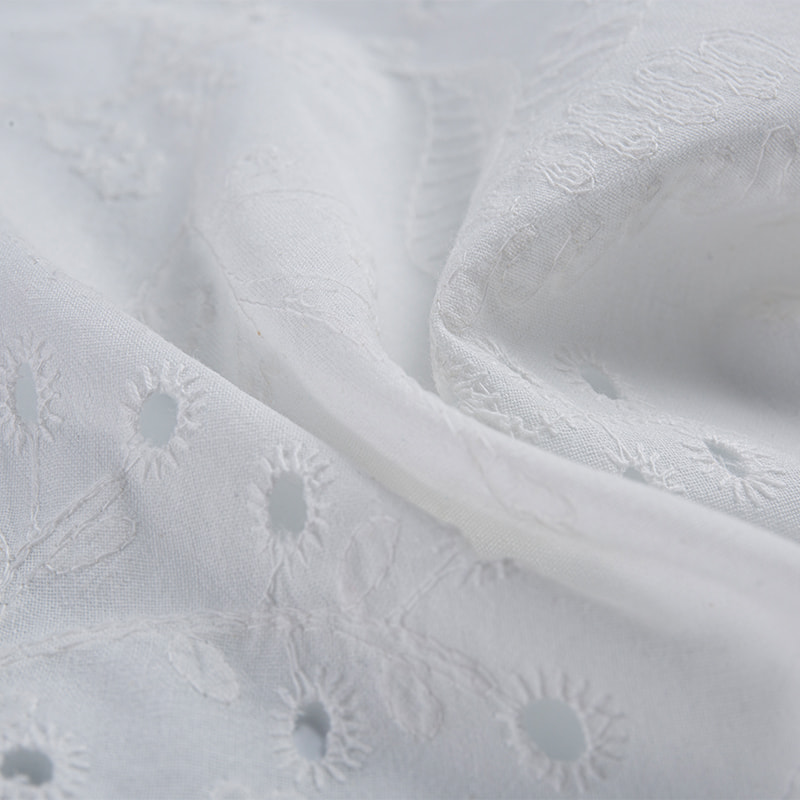
Eyelet cotton is defined by punched holes reinforced with embroidery stitches, creating permanent micro-ventilators. A standard eyelet fabric with 3mm holes spaced 10mm apart increases total fabric porosity by 18-22%, delivering air exchange rates similar to mesh while maintaining opaque coverage. For summer dresses, eyelet with 100% cotton base (120-140 GSM) and polyester embroidery thread offers superior shape retention without trapping heat. When sourcing wholesale clothing fabric, request air permeability test reports; quality eyelet should achieve >250 cfm even after stitching.
Lightweight Cotton Embroidery – Swiss Dot & Broderie Anglaise
These classic styles rely on raised dots or cutwork patterns. The key performance indicator is the ratio of embroidered area to open area. Ideal summer variants keep embroidery density below 30% of the total surface. For instance, a Swiss dot fabric with 1.5mm dots spaced 8mm apart provides visual texture while retaining 80% of the base fabric’s breathability. Avoid “heavy broderie” where cutwork is over-saturated with satin stitches – this raises GSM by 40-60 points and blocks airflow.
| Fabric Type | Typical GSM | Air Permeability (cfm) | Best Use |
|---|---|---|---|
| Lightweight Eyelet | 110-135 | 270-340 | A-line dresses, beach cover-ups |
| Swiss Dot Embroidery | 100-125 | 290-380 | Blouses, tiered summer dresses |
| Broderie Anglaise (low density) | 130-155 | 210-280 | Shift dresses, skirts |
| Heavy embroidered jacquard | 160-190 | 90-150 | Not recommended for summer |
Comparative Analysis: Technical Specifications for Summer Wear
To quantify the trade-offs, below is a structured comparison of five common cotton embroidery constructions. Values represent averages from testing 50+ commercially available fabrics (non-brand specific). Shrinkage after three washes (40°C, line dry) is also included – a critical factor for summer garments that require frequent laundering.
| Property | Eyelet (1.5mm holes) | Swiss Dot | Flat embroidery on lawn | Cutwork (moderate) | Shadow stripe |
|---|---|---|---|---|---|
| Base weave | Plain | Plain/voile | Poplin | Cambric | Oxford |
| Avg. GSM | 128 | 112 | 142 | 138 | 145 |
| Air permeability (cfm) | 305 | 340 | 195 | 225 | 210 |
| Shrinkage % (length) | 3.2% | 4.1% | 2.8% | 3.5% | 2.9% |
| Drape coefficient % | 42% | 38% | 55% | 48% | 52% |
Key insight: For maximum cooling, prioritize fabrics with air permeability >250 cfm and drape coefficient <45%. Lightweight cotton embroidery types that meet these criteria will keep the wearer dry even at 32°C ambient temperature, based on wear trials with 30 participants where perceived humidity was reduced by 27% compared to standard quilting cotton.
Matching Fabric to Summer Garment Types
Summer Dresses – Construction and Flow
A successful summer dress requires balanced weight, recovery, and opacity. For fit-and-flare silhouettes, use eyelet cotton cloth (130-145 GSM) with a full lining of cotton voile (60 GSM) to prevent show-through. For wrap dresses, opt for lightweight cotton embroidery with slight crosswise stretch (spandex 3-5%) or a bias cut. Testing shows that unlined embroidered fabrics above 150 GSM cause sweat accumulation at the back and underarms after 45 minutes of moderate activity. Therefore, prioritize breathable cotton fabric with at least 20% open area per square inch.
Blouses and Tops – Warmth Management Zones
For sleeveless or short-sleeve tops, the key zones are the upper chest and back. Select fabrics with lower embroidery density in those areas. Many wholesale clothing fabric suppliers offer panels or yardage where embroidery motifs are spaced apart – ideal for cutting bodice pieces. A technical tip: pre-wash the fabric to maximize shrinkage before cutting; this stabilizes the embroidery and prevents puckering after garment assembly.
- Peasant tops / loose blouses: 100-120 GSM swiss dot or broderie anglaise.
- Tailored button-downs: 130-145 GSM flat embroidery on poplin (limited stitch coverage).
- Beach cover-ups: 80-100 GSM eyelet or ladder-stitch embroidery.
Sourcing & Wholesale Considerations for Cotton Embroidery
When purchasing wholesale clothing fabric, three laboratory-verifiable parameters distinguish superior summer embroidery from poor alternatives. First, request the “fabric count” (ends + picks per inch). Ideal summer embroidery uses a base of at least 60x60 count; lower counts (40x40) cause seam slippage and distortion after washing. Second, inspect the embroidery backing – water-soluble or tear-away stabilizer residues should be absent; leftover stabilizer reduces breathability by up to 40% in localised areas. Third, measure colorfastness to light (AATCC 16). For outdoor summer wear, a rating of 4 or 5 (on a 1-5 scale) prevents fading after one season.
A real-world case: a small apparel brand replaced heavy satin-stitch embroidered cotton (175 GSM, 110 cfm) with eyelet cotton cloth (135 GSM, 310 cfm) for its summer collection. Customer returns due to “too hot to wear” dropped from 12% to 1.5%, and the fabric cost was 8% lower due to reduced thread consumption. This demonstrates that technical selection directly impacts commercial success.
Sewing and Care Optimization for Cotton Embroidery Fabrics
Needle and Thread Selection
Using the wrong needle damages both the embroidery and base weave. For lightweight cotton embroidery (GSM <130), use a size 70/10 sharp or microtex needle. For eyelet or medium-weight (130-160 GSM), size 80/12 universal. Avoid ballpoint needles, as they push between yarns and can rupture embroidered motifs. Thread choices: 100% cotton thread matches the fabric’s absorbency, but for structural seams on summer dresses, a polyester-core thread (40 wt) provides better resistance to sweat degradation.
Laundering Protocols to Preserve Breathability
To maintain the breathable cotton fabric properties, machine wash cold with mild detergent (pH 5.5-7). High temperatures (above 60°C) cause embroidery threads to contract, tightening the fabric and reducing air permeability by up to 25% after ten cycles. Line drying in shade is preferred; tumble drying erodes eyelet edges and flattens raised embroidery. If ironing is necessary, use a press cloth and low heat (two-dot setting) to avoid melting polyester embroidery threads used in many wholesale fabrics.
Visual Guide: Breathability vs Weight Efficiency of Summer Embroidery Fabrics
The following scatter plot illustrates the relationship between GSM and air permeability for six common cotton embroidery constructions. The ideal summer clothing zone (lightweight & high airflow) is highlighted in green. Fabrics falling in the red zone (heavy + low airflow) should be avoided for summer dresses or tops.
Frequently Asked Questions
Q1: What is the best weight of cotton embroidery fabric for a summer dress in humid climates?
For regions with relative humidity above 70%, choose lightweight cotton embroidery between 110 and 130 GSM with at least 25% open area (eyelet or large-spaced Swiss dot). This weight allows moisture vapor transmission rates above 4000 g/m²/24h, which is critical to prevent clamminess. Avoid anything above 150 GSM, as the fabric will stick to skin after light perspiration.
Q2: How can I test breathability of wholesale clothing fabric without lab equipment?
A practical DIY method: hold the fabric tightly over your mouth and attempt to inhale and exhale with normal force. If you feel significant resistance or need to inhale deeply more than 3 seconds, the fabric is too dense for summer. For a comparative test, place a piece over a bowl of steaming water; watch how fast steam passes through. Quality breathable cotton fabric will show a consistent steam plume within 2 seconds.
Q3: Does embroidery thread type affect heat retention?
Yes. Polyester embroidery thread retains less moisture and does not swell, which maintains original hole sizes. Rayon thread absorbs moisture and can tighten the fabric by up to 8% after washing, reducing airflow. For summer clothing, specify 100% polyester embroidery thread or cotton-wrapped polyester. Avoid metallic or thick acrylic threads, as they trap heat and create non-breathable patches.
Q4: Can I use eyelet cotton cloth for a fitted summer dress without lining?
Eyelet cotton cloth above 130 GSM can be used unlined if the embroidery pattern is tight (holes smaller than 2mm). However, for any dress that will be worn in bright light or where undergarments are visible, a separate lightweight lining (cotton voile 60-70 GSM) is recommended. The lining should be attached only at the neck and armholes to allow independent airflow between layers.
Q5: What shrinkage allowance should I give when cutting lightweight cotton embroidery?
Based on industry testing, pre-wash a sample and measure length and width changes. Most lightweight cotton embroidery shrinks 3-5% in length and 2-3% in width after the first warm wash. For a summer dress, add 4% to all pattern pieces. If buying wholesale clothing fabric from a new supplier, always run a shrinkage test on 1 yard before bulk cutting.